Showing posts with label diamond history. Show all posts

Tuesday, January 5, 2010

A Loose Diamonds Travel-Rough to Polish

loose diamonds
Mining: Over 250 tons of ore need to be mined to yield a one-carat rough diamond. On the other hand, only about 20 percent of all rough diamonds are appropriate for use as gems. Given that diamond is the hardest material known to man, the rest of the diamonds are used for industrial purposes, such as cutting, boring and grinding. Loose Diamonds are mined in the deepest area of Kimberlite Magma pipes up to 75 miles deep called "blue rock" or "blue ground", as well as in the shallower area 50 to 60 feet beneath the earth's surface called "yellow ground." At present, more than 90 percent of the world's diamond supply is mined in South Africa. However, diamonds are also mined in Australia, South America, Russia and Canada.

Marking, which is the first step in the diamond making procedure, is done after each rough diamond is analyzed in order to make a decision how it should be cut to yield the greatest value. Here, the shape of the rough diamond, and the number and location of impurities and imperfections are believed. Taking these factors into account, the planner decides how the diamond should be cut and "marks" it to point out where the stone should be cleaved or sawed.

Cleaving: subsequent to a diamond is marked, depending on the particular stone, it is sent to a cleaver or a sawyer. When the stone is very large and precious, cleaving it is a critical process, since a mistake by the planner or the cleaver can shatter the diamond. The cleaver's job is to cut the diamond into two pieces, in order to fetch out the best angles and set up what the final cut will be. Sawing: Sawing is consummate by using a blade that is paper-thin, turns at 4,000 rpm, and is made of phosphor bronze. Based on the size of the diamond, each diamond is clamped resting next to the rotating blade for several hours. Since diamonds are the hardest substance on earth, they can only be cut by another diamond, and that is why diamond dust is used, as well as the real diamond dust generated by the crystal being cut.

Cutting: Girdling or rounding are terms that come into participating when cutting a round stone. Each diamond is placed into a lathe, with a second diamond held next to it, too slowly round it into a cone shape. After that the stone goes to the blocker, who places the first 18 main facets on a brilliant-cut loose diamond, after which it goes to the brillianteer, who must place the staying 40 facets. The above process, of cutting of 58 facets enforces to Round Brilliant loose diamonds. For fancy shaped loose diamonds the process rather varies.

Polishing: The last step in the loose diamond finishing process is polishing. The loose diamond is imposed onto a rotating wheel that looks like a record turntable that is covered with diamond dust. The diamond dust is the rough that polishes away small imperfections

If you have extra question about loose diamonds or would like to add to our loose diamond education pages please contact us.

Thursday, August 27, 2009

Shapes of Diamonds

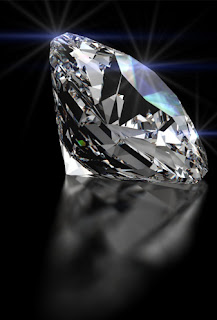
Round Brilliant
Round diamonds are the most well-liked of all the shapes, possibly because their circular proportions display the most "fire" and reflect more light back to the observer than any other shape. Round diamonds require that more rough be removed through cutting and polishing than with other shapes. The combined popularity of round diamonds and the important weight loss during cutting are the two main causal factors to the relatively higher price of these stones.

Princess
The Princess cut is a square cut with sharp ends. It has extremely good fire and a high degree of brilliance. The princess cut utilizes most of the unique shape of the rough diamond and the weight loss from cutting is low. As a consequence, its price is typically more attractive than a comparative round cut with the same weight.

Emerald cuts
Emerald cuts are smooth and stylish. The Emerald cut is rectangular by means of cut corners. It is a step cut - its facets being broad with flat planes like the steps of a stair. Higher quality Emerald cuts are favored because its cut makes inclusions and lower color grades more obvious than with other cuts. The emerald cut diamond can be totally stunning. Because of its long lines, it tends to be less burning than a "round brilliant" cut, but it also tends to have broader, more dramatic flashes of light.

Marquise
The Marquise cut is boat shaped and is a difference of the round brilliant cut diamond. Marquise cuts are often chosen by women who wish to show an independence of style. Its elongated form can make the illusion of longer, narrower fingers.

Radiant
This is a customized or combination cut - a brilliant cut square or rectangle shaped diamond with clipped-off corners similar to the emerald cut. It melds the stylishness of the emerald cut diamond with the brilliance and sparkle of the round diamond.

Pear
The Pear cut is a tear-drop shape and is a disparity of the round brilliant cut diamond. This attractive diamond is also very well-suited to pendants and earrings. Lots of the largest stones ever discovered have been cut and faceted into wonderful pear-shapes.

Heart shape
The ultimate symbol of love, the romantic Heart shape is a difference of the round brilliant cut diamond. This ultimate symbol of romance is basically a pear-shaped diamond with a cleft at the top. The ability of the cutter determines the beauty of the cut. Appear for a stone with a yet shape and a well-defined outline.

Oval
The Oval cut is egg-shaped in shape and is a variation of the round brilliant cut diamond. The oval shaped diamond gives a pleasing delusion of length to the finger and hand, and is well-liked among women with small hands or short fingers. It can also emphasize long, slender fingers.

Asscher
The Asscher cut is an alternative of the emerald cut and provides a uniquely regal and elegant look to its wearer. Its art-deco styling combines old-world charm with contemporary cutting and faceting techniques to create a dazzling example of brilliance.

Tuesday, July 28, 2009

Facts About DIamonds

Diamond facts

* All diamonds are at least 990,000,000 years old. Many are 3,200,000,000 years old (3.2 billion years)

* Diamonds are formed deep within the Earth: between 100 km and 200 km below the surface.

Diamonds form under remarkable conditions!

o The temperatures are about 900 - 1300 C in the part of the Earth's mantle where diamonds form
o The pressure is between 45 - 60 kilobars (kB)
+ 50 kB = 150 km = 90 miles below the surface
+ 60 kB = 200 km = 120 miles below the surface
Diamonds are carried to the surface by volcanic eruptions.
The volcanic magma conduit is known as a kimberlite pipe or diamond pipe. We find diamonds as inclusions in the (rather ordinary looking) volcanic rock known as kimberlite.

NOTE: The kimberlite magmas that carry diamonds to the surface are often much younger than the diamonds they transport (the kimberlite magma simply acts as a conveyer belt!).

* Diamond is made of carbon (C), yet the stable form (polymorph) of carbon at the Earth's surface is graphite.

graphit1.png

* To ensure they are not converted to graphite, diamonds must be transported extremely rapidly to the Earth's surface.

It is probable that kimberlite lavas carrying diamonds erupt at between 10 and 30 km/hour (Eggler, 1989). Within the last few kilometers, the eruption velocity probably increases to several hundred km/hr (supersonic!).

* Diamond is the hardest material

Diamond is the hardest gem on MOHS harness scale and graphite (also made from carbon atoms) is the softest !! Given that both diamond and graphite are made of carbon, this may seem surprising.


The explanation is found in the fact that in diamond the carbon atoms are linked together into a three-dimensional network whereas in graphite, the carbon atoms are linked into sheets with very little to hold the sheets together (thus the sheets slide past each other easily, making a very soft material).

Diamonds occur in two general types of deposits world wide:

* volcanic pipes, also known as kimberlite pipes
* alluvial, or placer, deposits, which were formed by the erosion of diamond pipes over millions of years.

The earliest productive mines were in the Golconda region of India, particularly along the Kristna River. After 1725 this mining district was gradually eclipsed in importance by the diamond deposits of Brazil. Diamonds were first mined there along the Jequitinhonha River, in the Diamantina area of the state of Minas Gerais.

In 1867 a 21-carat stone was discovered on the banks of the Orange River near Hopetown, South Africa. A great diamond rush started, and new deposits were discovered that were more productive than any the world had ever known. Another major diamond resource was developed in the 1950s in the Yakutia region of the Soviet Union. By the 1980s the Yakutia and South African regions and the country of Zaire dominated the world's diamond market. The mineral has also been found in smaller amounts in numerous other places. In the United States the leading producers include Arizona, Nevada, and Montana, although the largest gemstones have been found in an eroded volcanic pipe in Pike County, Ark.
zaire.jpg rough diamond1.jpgbighole-south africa-diamond mine.png diamond mine yakutia.jpg rough- in hand.jpg diamond sorting.jpg dede-beim schleifen.png


For many years, microscopic diamonds have occasionally been noted in meteorites; they were attributed to high-speed collisions in space or with the Earth. In 1987, however, following the discovery of many more such diamonds, the theory was developed that they are the product of ancient supernova explosions of giant stars.

In recent years, diamonds have been found in unusual metamorphic rocks that were subjected to very high temperatures and pressures.


HOW RARE ARE DIAMONDS?

· How many grams do you need to mine to get 5 grams of diamonds?

(5g/1000 kg) @ 1000 g/kg = 5 g /1,000,000 g!

BUT only 20 % are gem quality (80 % of these are sold in a 'managed selling environment') and the remainder are used for industrial purposes (this material is known as 'bort' or 'carbonado' (carbonado is finer)).


CHARACTERISTICS OF DIAMOND:

· Hardness = 10

· Crystal System = cubic

· This is what crystals look like before they are faceted: note their natural octahedral shape!

Uncut diamonds are also found in cubic forms

· Diamond has four good cleavages, thus diamonds tend to cleave on impact

· Other diagnostic properties.


Other issues: Treatment, simulants, synthetics

(1) TREATMENTS:

* (a) filling of cracks

Surface cracks and cleavages reaching the surface: often with a glass-like material

Identification: optical microscope examination:

+ =greasy appearance
+ =flash effect
+ =bubbles

Problem: Filling does not always resist polishing and cleaning

* (b) drilling of inclusions
+ Drilling inclusions involves use of a laser.

Solutions can be poured into the resulting "hair-width" diameter hole to bleach colored inclusions.

* (c) irradiation

Irradiation is used to change the color of the diamond. A common color produced by irradiation is green.

Early attempts: beginning of 20th Century: diamonds exposed to radium - the problem was that the diamonds remained radioactive!! However, modern irradiation treatments do not produce radioactive stones.

Irradiation involves the use of devices such as:

o (1) linear accelerators

o (2) gamma ray facilities

o (3) nuclear reactors

Detection of irradiation treatment:

Electron irradiation only changes the surface of the stone. Thus, it produces a concentration of color where the gemstone is thin. For example, electron irradiation produces a color concentration at the culet or keel line of the faceted gem

(2) SIMULANTS

Simulants - simulate the appearance of diamond

The distinction between a synthetic diamond (man-made diamond consisting of carbon atoms arranged in the typical diamond structure) and a diamond simulant (not a carbon compound with the diamond structure) is VERY important!!

In order of increasing R.I., the most common simulants are:

1. YAG = yttrium aluminum garnet
2. GGG = gadolinium gallium garnet
3. CZ = cubic zirconia
4. Strontium titanate
5. diamond.

This rhyme can be used to memorize the common diamond simulants in the above order:

You go crazy staring at diamonds.

Again: Simulants (look alsikes) differ from synthetics (synthesized by humans!) !!!!

Simulants are distinguished from diamonds using measurement or observation of various properties, such as:

o R.I.
o "Read through effect"
o Dispersion
o Hardness
o Specific Gravity
o Reflection pattern
o Shadow patterns

Note: not all diamond simulants have been around for the same length of time!

(3) SYNTHESIS (Details on gem synthesis)

Synthetic diamonds are often yellowish in color (rarely used for gem purposes, more commonly used as diamond grit for industrial purposes. Modern synthesis of thin film diamond has other industrial applications).

A 5 mm diamond (0.5 carat) takes over a week to grow. Synthesis requires:

* high pressure
* high temperature
* a special apparatus

Synthetic diamonds can sometimes be distinguished from natural diamonds by the presence of flux inclusions (Ni, Al or Fe).

Also see Other Blog on Diamond: Diamonds Exotica

Friday, July 10, 2009

History Of Diamond


The name diamond is derived from the ancient Greek ἀδάμας (adámas), "proper", "unalterable", "unbreakable, untamed", from ἀ- (a-), "un-" + δαμάω (damáō), "I overpower, I tame".However, diamonds are thought to have been first recognized and mined in India, where significant alluvial deposits of the stone could then be found many centuries ago along the rivers Penner, Krishna and Godavari. Diamonds have been known in India for at least 3,000 years but most likely 6,000 years.

Diamonds have been treasured as gemstones since their use as religious icons in ancient India. Their usage in engraving tools also dates to early human history.[ Popularity of diamonds has risen since the 19th century because of increased supply, improved cutting and polishing techniques, growth in the world economy, and innovative and successful advertising campaigns.

In 1813, Humphry Davy used a lens to concentrate the rays of the sun on a diamond in an atmosphere of oxygen, and showed that the only product of the combustion was carbon dioxide, proving that diamond is composed of carbon. Later, he showed that in an atmosphere devoid of oxygen, diamond is converted to graphite.

The most familiar usage of diamonds today is as gemstones used for adornment, a usage which dates back into antiquity. The dispersion of white light into spectral colors is the primary gemological characteristic of gem diamonds. In the twentieth century, experts in the field of gemology have developed methods of grading diamonds and other gemstones based on the characteristics most important to their value as a gem. Four characteristics, known informally as the four Cs, are now commonly used as the basic descriptors of diamonds: these are carat, cut, color, and clarity.